We use cookies to measure ad performance and improve the site. Read our privacy policy.
Search ads - Google, Microsoft, PMax & AI Max
Free search ads audit
Takes about a minute
Partner certified
Microsoft
Ads certified
14+
Industries managed
9+ yrs
Managing search campaigns
The question everyone's asking
Yes - and the reason is simple: AI Overviews mainly disrupt informational searches, not the transactional, ready-to-book searches paid search ads are built to capture.
Direct answer
Someone typing "why is my pool green" might get a fully satisfying AI-generated answer and never click anything. Someone typing "pool cleaning service near me" still needs an actual company to book - an AI summary cannot fix their pool. That distinction is why zero-click impact hits informational and research-stage content far harder than local, transactional, high-intent searches.
Search and Shopping ads continue to appear above and below AI Overviews, and are being tested within them for many commercial-intent queries - though currently excluded for sensitive categories like healthcare and finance.
Accounts leaning on broad, informational keywords feel the most pressure from AI Overviews. Accounts built around local, transactional, high-intent keywords hold up far better.
Organic visibility inside an AI Overview is largely outside your control. A search ad's placement, spend, and return are still something you can directly manage - that control is worth more as the results page gets less predictable.
Four ways to run search ads today
"Search ads" isn't one single product anymore - here's how each of the four actually works, and how they fit together.
Keyword-targeted text ads on Google's search results - the highest-intent, most controllable format, and where most search budget should start. Built on Quality Score, tight ad groups, and message-matched landing pages.
Google Ads managementThe same keyword-bidding mechanic, running on Bing, Yahoo, AOL, and DuckDuckGo - typically 30-40% lower CPC, reaching an audience Google alone does not fully cover.
Microsoft Ads managementPulls from Search inventory as one of several channels - alongside Display, YouTube, and Gmail - using asset groups and automated bidding instead of manual keywords.
Layers AI-powered query matching and ad copy generation on top of your existing Search campaigns - expanding reach beyond your keyword list without replacing your account structure.
The trade-off worth understanding
PMax genuinely does serve on Google's Search inventory. It just doesn't let you see or control it the way a standard Search campaign does.
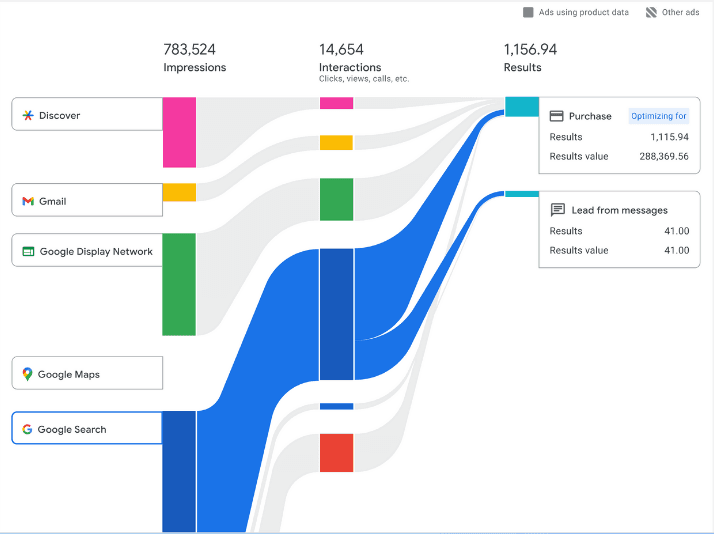
Instead of keywords, you provide asset groups - headlines, images, descriptions - and Google's algorithm decides where and to whom they show, including within Search results, based on your ROAS or conversion goal.
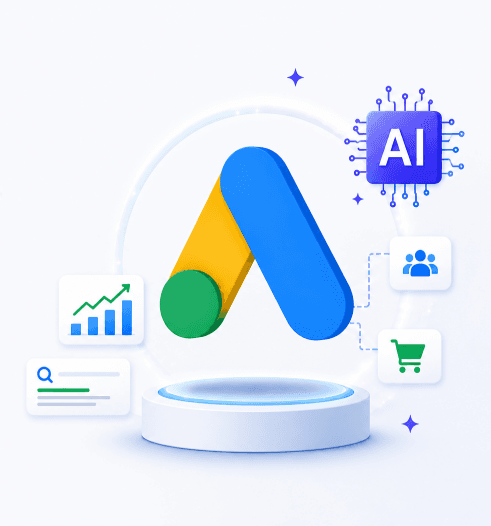
Search term reporting in PMax is limited compared to a standard Search campaign, which makes it harder to see exactly which searches triggered your ads. It's a reasonable complement to Search campaigns once you have strong conversion data - not usually the right starting point on its own.
Google's newest layer on Search campaigns
AI Max isn't a new campaign type - it's an optimization layer inside your existing Search campaigns, built around two core capabilities.
Expands reach beyond your keyword list using broad match, asset-based, and landing-page-based matching, catching relevant searches your exact keyword list would otherwise miss.
AI generates ad copy variations from your existing assets and site content, and can route clicks to the most relevant page on your domain automatically.
Google's own reported data shows accounts using the full AI Max feature suite see roughly 7% more conversions or conversion value at a similar CPA/ROAS compared to search term matching alone.
Worth knowing before you adopt it
Campaigns using Dynamic Search Ads, automatically created assets, or campaign-level broad match are being migrated to AI Max automatically - a rolling process through 2026 and into early 2027. Any AI-generated ad element now also requires a small disclosure label. We review every account's AI Max settings individually rather than leaving the defaults in place, since automatic upgrades don't account for your specific keyword strategy.
The second search engine
Microsoft Search Ads work exactly like Google's - bid on keywords, win an auction on bid and Quality Score, pay per click - but run across Bing, Yahoo, AOL, DuckDuckGo, and Microsoft's partner network, reaching an audience that skews older and higher-income.
The same keyword on the same intent generally costs less to win, because fewer advertisers are bidding on it - a small budget covers more searches.
Target by company, industry, or job function using LinkedIn data - there is no Google Ads equivalent, which matters for B2B accounts.
Worth adding once Google Search Ads are stable and converting, rather than as a first move or a copy-paste import of the whole account.
Why this channel converts
Search ads work because they show up at the exact moment someone has already decided they need something - not while they're scrolling and might be interested.
Someone searching "water heater installation cost" has already decided to buy - search ads meet that decision at the moment it happens, unlike display or social ads that interrupt browsing.
A new business with zero organic search history can appear at the top of results the same day a campaign launches - SEO takes months to build that same visibility.
Every click, call, and form fill traces back to a specific keyword and ad - budget can be shifted toward what's actually converting, not what feels like it should be working.
Questions people search before they ask us
Ready when you are
A free audit reviews your current search ads setup - or your market, if you're starting fresh - across Google, Microsoft, PMax, and AI Max eligibility, with a clear, prioritized recommendation.